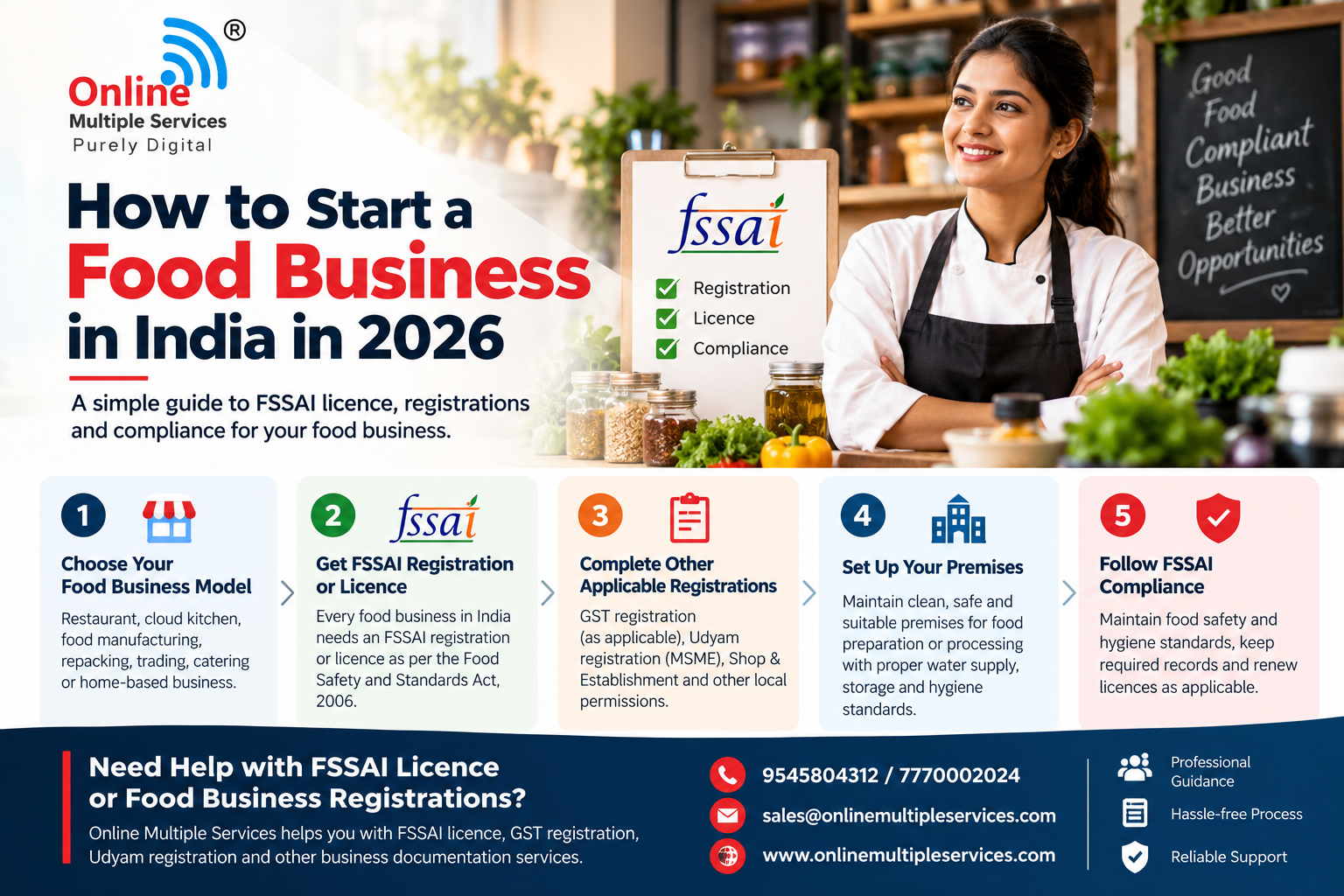
Starting a food business in India in 2026? 🚀 Whether you want to open a restaurant, cloud kitchen, bakery, catering service, food manufacturing unit, or home-based food business, getting the right registrations and licences is an important first step.
From FSSAI Registration and Food Licence to GST, Udyam Registration, and local business permissions, understanding the requirements can help you start your business with greater confidence.
At Online Multiple Services, we help entrepreneurs understand business registration requirements and access documentation assistance for their business needs.
In this guide, we explain the essential steps to start a food business in India in 2026.
📌 Table of Contents
- 🍴 Types of food businesses in India
- 📝 FSSAI Registration and Licence categories
- 📂 Documents required for FSSAI
- 💻 How to apply for an FSSAI Licence online
- 🏢 Other registrations you may need
- 🧼 Food safety and hygiene requirements
- ⚠️ Common mistakes to avoid
- 🤝 How Online Multiple Services can help
- ❓ Frequently asked questions
🍴 1. Choose Your Food Business Model
Before applying for any registration, decide what type of food business you want to establish.
Here are some popular options:
🍽️ Restaurant or Café – Prepare and serve meals, snacks, and beverages.
🥡 Cloud Kitchen – Prepare food for online orders, takeaway, and delivery.
🎂 Bakery or Home-Based Food Business – Sell cakes, cookies, snacks, sweets, pickles, and other homemade food products.
🏭 Food Manufacturing Unit – Manufacture, process, package, or produce food products.
🚚 Food Distribution or Trading – Purchase and distribute food products to retailers, businesses, or customers.
🎉 Catering Business – Provide food services for weddings, parties, corporate events, and other occasions.
📦 Packaged Food Business – Sell packaged snacks, spices, ready-to-eat products, and other food items.
💡 Tip: Your business activity determines the applicable FSSAI category and may affect which additional registrations or permissions you need.
📝 2. Understand FSSAI Registration and Licence in 2026
FSSAI stands for the Food Safety and Standards Authority of India. It regulates food safety under the Food Safety and Standards Act, 2006.
Food businesses generally need the applicable FSSAI registration or licence before commencing operations, subject to specific exemptions or deemed-registration provisions.
📊 FSSAI Licence Categories in 2026
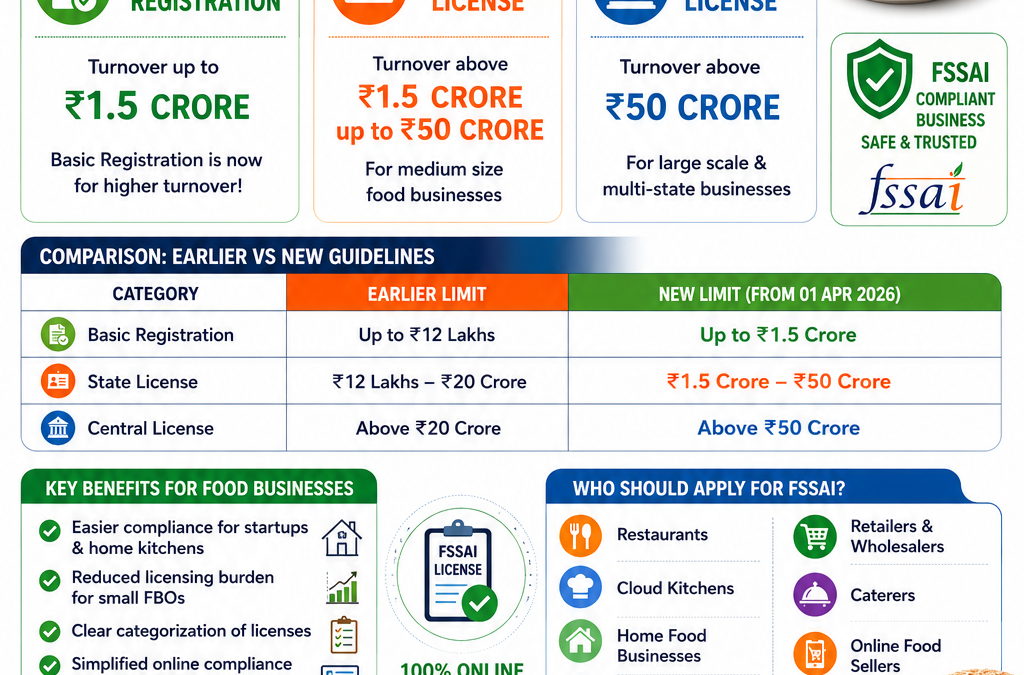
From 1 April 2026, FSSAI revised the turnover thresholds for categorising food businesses.
| Category | Annual turnover |
|---|---|
| 🟢 Registration | Up to ₹1.5 crore |
| 🔵 State Licence | Above ₹1.5 crore and up to ₹50 crore |
| 🔴 Central Licence | Above ₹50 crore |
Important: These are the revised turnover thresholds. Your business activity and any specific licensing conditions must also be checked. Certain businesses may require a particular licence regardless of turnover.
🟢 Basic FSSAI Registration
This category may apply to eligible small food businesses, including certain home-based food operators and small food retailers.
🔵 State FSSAI Licence
This category generally applies to eligible food businesses with turnover above ₹1.5 crore and up to ₹50 crore, subject to activity-specific rules.
🔴 Central FSSAI Licence
This category generally applies to eligible businesses with turnover above ₹50 crore. Certain activities, such as specified import and e-commerce operations, may require a Central Licence irrespective of turnover.
📂 3. Documents Required for FSSAI Registration
Preparing the correct documents can help make the application process smoother.
Common documents may include:
✅ Applicant’s identity and contact details.
✅ PAN details, where applicable or required.
✅ Proof of business address or premises.
✅ Rent agreement or ownership proof, where applicable.
✅ Details of the food business activity.
✅ Business constitution documents, where applicable.
✅ Photographs and other supporting documents, if required.
✅ Additional technical or food safety documents for applicable business categories.
📌 Please note: The exact document list depends on the type of business, its activities, and the registration or licence category. Food manufacturers and certain larger establishments may need additional documentation.
💻 4. How to Apply for an FSSAI Licence Online
Follow these general steps to begin your FSSAI application.
Step 1️⃣: Identify Your Business Activity
Decide whether you are operating a restaurant, cloud kitchen, bakery, catering service, food manufacturing unit, or another food business.
Step 2️⃣: Check Your Eligibility
Review the applicable registration or licence category based on your turnover, business activity, and other regulatory requirements.
Step 3️⃣: Prepare Your Documents
Collect the necessary identity, address, and business documents, along with any additional documents applicable to your category.
Step 4️⃣: Submit Your Application
Follow the instructions to apply under the appropriate category.
Step 5️⃣: Complete Any Additional Requirements
Respond to any requests for information, supporting documents, or other actions required by the relevant authority.
Step 6️⃣: Track Your Application
Monitor the application status and follow the instructions provided by the licensing authority.
🎯 Pro tip: Selecting the correct business category and preparing complete documentation can help reduce avoidable application errors.
🏢 5. Other Registrations Required for a Food Business
FSSAI is an important part of food business compliance, but other registrations may also apply.
🧾 GST Registration
GST registration depends on applicable turnover thresholds, the nature of supplies, location, and other legal conditions.
Not every food business has identical GST obligations.
🏭 Udyam Registration (MSME)
Eligible small businesses can register under the Udyam Registration system to access applicable MSME-related benefits and schemes.
🏪 Shop and Establishment Registration
Depending on the state and business activity, registration under the applicable Shops and Establishments law may be required.
🏛️ Municipal Trade Licence
Restaurants, cafés, and food outlets may need local municipal permissions or trade licences depending on the location and nature of operations.
🔥 Fire Safety and Premises Approvals
Applicable fire safety approvals, building-use permissions, and other premises-related requirements should be checked before starting operations.
🌐 Other Business Registrations
Depending on your business model, you may also need company incorporation, trademark registration, import-export registration, or other sector-specific approvals.
💡 Remember: Not every business requires every registration listed above. Identify the requirements applicable to your specific activity and location.
🧼 6. Food Safety and Hygiene Requirements
A successful food business needs more than registrations. Maintaining food safety and hygiene is essential for protecting customers and operating responsibly.
Important areas to consider include:
🧹 Clean Premises: Keep food preparation and storage areas clean and suitable for use.
💧 Safe Water Supply: Ensure water used for food preparation meets applicable safety requirements.
📦 Proper Storage: Store ingredients and finished products appropriately.
🪳 Pest Control: Follow suitable pest prevention and control practices.
👨🍳 Personal Hygiene: Maintain appropriate hygiene and safe food-handling practices.
🗑️ Waste Management: Dispose of food waste and other waste responsibly.
🏷️ Packaging and Labelling: Follow applicable food packaging and labelling requirements.
📋 Record Keeping: Maintain records required for your food business category.
Following these practices supports food safety and helps businesses meet their applicable regulatory obligations.
🆕 7. Important FSSAI Updates for 2026
Food entrepreneurs should be aware of significant changes introduced in 2026.
📈 Revised Turnover Thresholds
From 1 April 2026, the turnover thresholds for registration and licensing were revised to ₹1.5 crore for registration, above ₹1.5 crore up to ₹50 crore for a State Licence, and above ₹50 crore for a Central Licence, subject to the applicable rules.
♾️ Perpetual Validity Framework
FSSAI introduced a framework under which registrations and licences have perpetual validity unless suspended, cancelled, or surrendered. Businesses must still follow applicable safety, hygiene, and other regulatory requirements.
🛒 Street Food Vendor Provisions
Certain street food vendors registered with Municipal Corporations or Town Vending Committees may qualify for deemed FSSAI registration under the applicable provisions.
Always verify the latest official requirements for your business activity before applying.
⚠️ 8. Common Mistakes to Avoid
Avoid these common mistakes when starting your food business:
❌ Choosing the wrong FSSAI category — Check the applicable eligibility rules.
❌ Submitting incomplete documents — Prepare the required documents before applying.
❌ Ignoring local permissions — Review applicable municipal and premises requirements.
❌ Overlooking GST obligations — Assess your GST requirements separately.
❌ Neglecting hygiene standards — Maintain appropriate food safety practices throughout your operations.
❌ Assuming one licence covers everything — Check whether additional registrations or permissions are needed.
✅ A little preparation can help you organise your registrations and establish a stronger compliance process.
🤝 9. How Online Multiple Services Can Help
Starting a new food business can involve multiple registrations, documentation requirements, and compliance considerations.
Online Multiple Services helps customers with registration applications and business documentation services.
Our services include:
📝 FSSAI Registration & Licence Assistance
🧾 GST Registration Services
🏭 Udyam Registration (MSME)
🏪 Shop Act Registration Assistance
🏢 Business Registration and Documentation Services
Our team can help you understand the relevant requirements and prepare for the application process according to your business needs.
Whether you are starting a cloud kitchen, restaurant, bakery, catering service, or home-based food business, we can discuss the documentation assistance relevant to your plans.
📞 Ready to Start Your Food Business?
Make your business registration process easier with Online Multiple Services.
Get in touch with our team to discuss FSSAI registration, licensing, GST registration, Udyam Registration, and other applicable business documentation services.
📱 Call Us: +91 95458 04312 / +91 77700 02024
📧 Email: sales@onlinemultipleservices.com
🌐 Website: https://www.onlinemultipleservices.com/
❓ Frequently Asked Questions (FAQs)
1. Is FSSAI registration mandatory for a food business in India?
Food business operators generally need the applicable FSSAI registration or licence. Specific exemptions and deemed-registration provisions may apply to certain categories.
2. What is the FSSAI registration turnover limit in 2026?
From 1 April 2026, the revised turnover threshold for registration is up to ₹1.5 crore. A State Licence generally applies above ₹1.5 crore and up to ₹50 crore, while a Central Licence generally applies above ₹50 crore, subject to activity-specific conditions.
3. Can I start a food business from home?
Yes. You may operate an eligible home-based food business subject to applicable FSSAI requirements and any relevant local, premises, tax, and other legal conditions.
4. Does a cloud kitchen need an FSSAI Licence?
Cloud kitchens generally need the appropriate FSSAI registration or licence. The applicable category depends on the business activity and relevant regulatory requirements.
5. Is GST registration compulsory for every food business?
No. GST registration requirements depend on turnover thresholds, the nature of supplies, location, and applicable legal provisions.
6. Does an FSSAI Licence need to be renewed every year?
Under the perpetual validity framework introduced in 2026, FSSAI registrations and licences remain valid unless suspended, cancelled, or surrendered. Applicable compliance obligations still need to be followed.
7. Can Online Multiple Services help me with FSSAI registration?
Online Multiple Services assists customers with FSSAI registration and licensing applications, along with other business documentation services. Contact our team to discuss your requirements.
🎯 Conclusion
Starting a food business in India in 2026 can be an exciting opportunity. However, understanding FSSAI registration, other applicable licences, tax obligations, and food safety requirements is an important part of building your business.
From choosing the right business model to preparing documents and completing the relevant registrations, planning ahead can make the process more organised.
Online Multiple Services is here to assist you with your business documentation needs.
📞 Call +91 95458 04312 / +91 77700 02024
🌐 Visit https://www.onlinemultipleservices.com/
Online Multiple Services — Your Partner for Business Registration and Documentation.